
A 30-day no sugar challenge sounds simple until day four, when there is cake at work and you realise you never decided whether a slice at a colleague’s leaving party counts.
Challenges that stop early rarely stop for lack of willpower. They stop on rules that were never pinned down (does honey count? ketchup?), on days that were never written down, and on a first slip that gets treated as the end of the month. Each of those is a planning problem, and each can be solved before day one.
This guide covers how to set the rules, what counts as sugar under the definitions public health bodies use, how to record all 30 days, what to do after a slip, and how to decide what happens on day 31. It is about habits rather than physiology, so it makes no claims about what a month without sugar does to your body. A paper calendar works for all of it, and so does an app.
How do you do a 30-day no sugar challenge?
Pick a start date and write one sentence that says exactly what is off the list, for example sweets, desserts and sugary drinks, plus any exceptions you are allowing. Move sweets out of easy reach, then record every one of the 30 days, including the sweet-free ones. If you slip, log it and carry on instead of starting over. On day 31, review your record and decide whether to continue, set a limit or cut back gradually.
What is a 30-day no sugar challenge?
A 30-day no sugar challenge is a time-limited experiment: for 30 consecutive days you cut out a defined group of sugary foods and drinks, keep a record, and then decide what to keep. The fixed end date is the point. Committing to a month is easier than committing to forever, and a month is long enough to include the things that usually knock a plan over: four weekends, a payday, a birthday or two, and at least one difficult week.
Some people call this a sugar detox. This guide avoids that label, because the challenge is a change of habit rather than a cleanse, and it promises nothing about weight, energy or health. What it reliably gives you is information: which sweets you miss, when you reach for them, and whether the rules you chose are ones you can live with.
Thirty days is not a magic number for a habit to settle, either. In a study of people taking up a new daily behaviour, such as eating a piece of fruit with lunch, researchers at University College London found that the time it took to feel automatic ranged from 18 days to an estimated 254 days. Treat day 30 as a checkpoint rather than a finish line.
Decide what counts as sugar before day one
Vague rules are where most challenges come apart. If you decide on day nine whether a sauce with sugar in it counts, you will decide in whichever direction suits you at that moment. Settle the questions in advance, while nothing is at stake.
Three versions of the challenge
There is no official rulebook, so choose a version on purpose. Most challenges fall into one of three:
| Version | Off the list | Usually still allowed | Best if |
|---|---|---|---|
| Sweets and sugary drinks | Chocolate, sweets, desserts, cakes, biscuits, ice cream, sugary soft drinks and sugar stirred into tea or coffee. | Everyday foods that contain some added sugar, such as bread or sauces, and whole fruit. | The habit you want to change is the sweets themselves, not every gram of sugar. |
| No added sugar | Everything above, plus packaged foods with added sugars on the label, honey, syrups and fruit juice. | Whole fruit, vegetables, plain milk and plain yogurt, and foods whose labels show no added sugars. | You already read labels, or packaged food is a large part of your week. |
| Strict | Everything above, plus sweeteners, diet drinks and dried fruit. | Fresh whole fruit, vegetables, and unsweetened food and drink. | You want as few sweet tastes as possible, and have time to check every label. |
The sweets and sugary drinks version is the easiest to keep and the easiest to record, because almost every decision can be made at a glance. The no added sugar version follows the public health definitions more closely, but means reading the label on most packaged food. The strict version leaves the fewest grey areas and asks for the most checking, so make sure you have the time for it.
Fruit, honey, juice and sweeteners: the grey areas
Most arguments about the rules come down to a handful of foods. The World Health Organization’s definition of free sugars is a useful tie-breaker. It covers sugars added to food and drink by the manufacturer, cook or consumer, plus the sugars naturally present in honey, syrups, fruit juices and fruit juice concentrates, and it does not refer to the sugars in fresh fruit and vegetables or the sugars naturally present in milk, according to theWHO announcement of its sugars guideline.
- Whole fruit is not a free sugar under that definition, so most versions of the challenge keep it. If fruit would simply take over the job the sweets used to do, decide in your rules how you will handle that.
- Honey and syrups count as free sugars, and in the US the FDA lists sugars from syrups and honey asadded sugars on the Nutrition Facts label. If honey replaces the sugar in your tea, the challenge has changed the ingredient rather than the habit.
- Fruit juice also counts as a free sugar, so a carton labelled “no added sugar” is still on the list under the second and third versions.
- Sweeteners and diet drinks are not sugar, so the first two versions often allow them. The useful question is about the habit: if a diet cola at 3pm is the same ritual as the sugary one, it keeps the routine going even though the sugar has gone. Neither answer is wrong. Choose one before you start.
Write the rules down, with the exceptions
Write the challenge as one or two sentences you could read out to someone else. For example: “For 30 days from 1 November, no chocolate, sweets, desserts, biscuits, ice cream or sugary drinks, and no sugar in coffee. Fruit is fine. One slice of cake at my sister’s birthday on the 18th, recorded like any other sweet.”
An exception decided in advance is part of the plan, not a breach of it. That difference matters on the day: a slice of birthday cake you chose a month ago is a decision you are keeping, while an unplanned one can feel as though the challenge is already over. Keep the list of exceptions short. A challenge with ten of them is a different challenge.
Set up a record that counts every day
The record is what turns a month of good intentions into something you can learn from. A paper calendar with a tick or a cross on each date works, and so does an app. Whatever you use, the rule is the same: record every day, including the days you had nothing sweet.
A blank day is not a sweet-free day. It is a day with no information, and after a week of blanks you cannot tell whether the challenge is going well or has quietly stopped. A one-line note each evening is enough to tell the two apart.
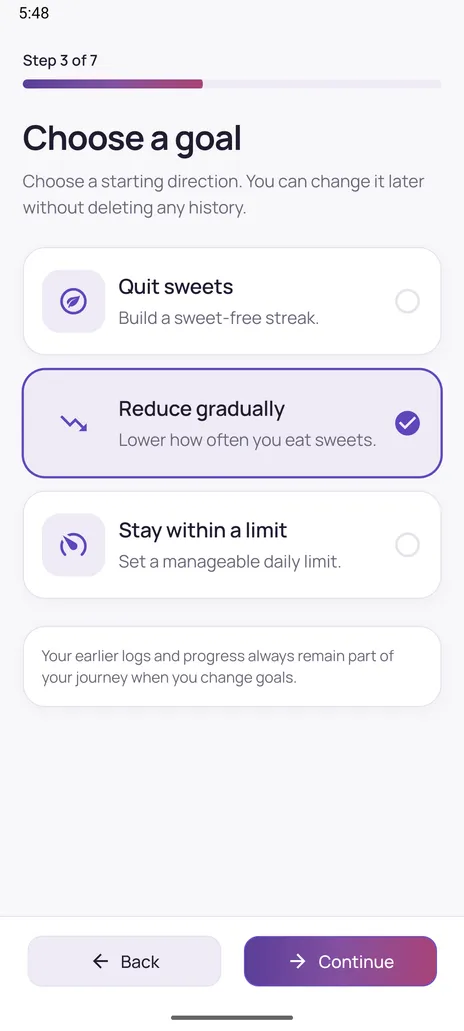
If you use Quit Sweet, set the challenge up as aQuit sweets goal, the mode built around a sweet-free streak. The goal can be changed later without deleting any history, which matters once you reach day 31.
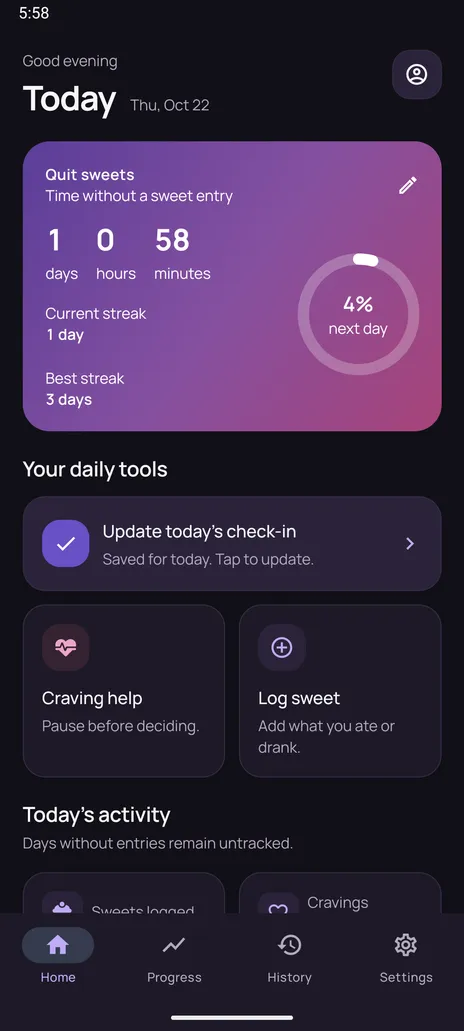
In Quit sweets mode, the home screen shows the time since your last sweet entry next to your current and best streak. One detail is worth knowing before you start: a day only counts toward the streak when something is recorded on it, whether that is a sweet, a craving or a daily check-in. On a sweet-free day, thedaily check-in, which asks for your mood and how noticeable cravings have been, is the quickest way to mark the day as tracked.
To make the daily record hard to forget, attach it to a fixed time, such as just before bed. Quit Sweet’s local reminders include an evening reflection that opens the check-in, scheduled on your phone rather than sent from a server.
Plan for the situations that test a challenge
A challenge rarely ends on a quiet Tuesday. It ends at an office birthday, after a long day, on a Friday night, or when someone offers you something and saying no feels awkward. Those moments can be planned for:
- Clear the supply before day one. Give sweets away, or move them to an opaque tin somewhere inconvenient. Every sweet within reach is a decision you have to make again each time you see it.
- Replace the slot, not just the sweet. If dessert ends every evening meal, decide what ends it instead: a hot drink, fruit if your rules allow it, or clearing the table straight away.
- Have a sentence ready for offers. “I’m doing a month without sweets” is usually enough, and saying it early in the month means you only have to explain once.
- Eat regular meals. Going for hours without food and then fighting the urge for something sweet is often a fight with hunger. The guide onhow to stop sugar cravingsexplains how to tell the two apart.
- Know what you will do when a craving hits. A delay of a few minutes, with something to do in the meantime, turns an automatic reach into a decision. Quit Sweet’sfive-step craving pause walks through that and records each craving’s strength, trigger and outcome.
What can you eat on a no sugar challenge?
Anything your rules do not exclude. In the sweets and sugary drinks version, that means your usual meals without the sweet extras. Under a no added sugar rule, it means mostly unprocessed food, plus packaged food whose label shows no added sugars.
What most people need is a replacement for particular moments rather than a new diet. A few that fit most versions of the challenge:
- Instead of a sweet drink: still or sparkling water with a slice of lemon or lime, unsweetened tea, or coffee without sugar.
- Instead of an afternoon snack: a piece of whole fruit if allowed, a handful of nuts, some cheese, or plain yogurt.
- Instead of dessert: a hot drink, a piece of fruit, or simply getting up from the table.
These are swaps for a routine, not nutritional advice. If you follow a diet set by a doctor or dietitian, keep to it. If most of your sugar comes from drinks, the guide on cutting down on sugary drinkscovers swaps for specific drink occasions.
What happens if you slip during the challenge?
A slip means you had something that is on your list. Record it honestly, with the real time and what set it off, and continue the challenge from your next meal. There is no need to go back to day one unless that is the rule you set in advance.
There are two reasonable ways to score a 30-day challenge, and it is worth choosing one before you begin:
- Strict count: any slip resets the count to day one. It is clear, but a slip on day 26 can make the whole month feel wasted, and that is a hard moment to keep going from.
- Calendar count: the challenge runs for 30 calendar days whatever happens, and the result is how many of them were sweet-free, for example 27 out of 30. It is less dramatic, and it keeps a full month of information.
In Quit Sweet, a sweet entry resets the current streak, as you would expect. Your best streak, the number of sweet-free days you have already recorded and any achievements you have unlocked stay as they were, so one slip changes one number rather than the whole record. If a single sweet tends to turn into a week off, the guide to restarting after a broken streak goes through the first day after it in detail.
Day 31: how do you know if the challenge worked?
Judge the challenge by what you learned, not only by whether every day was perfect. Look at how many of the 30 days you recorded, how many were sweet-free, where the slips happened, and which rules turned out harder than expected. Five questions cover most of it:
- How many of the 30 days did you record? If many are blank, that is the first thing to fix, whatever you do next.
- How many were sweet-free, and what was the longest run?
- When did the slips happen? Weekends, evenings, social events and stressful days are good places to look first.
- Did cravings change over the month? Compare how often they came and how strong they felt in the first week and the last. Your own notes answer this better than any general timeline.
- Which rule was harder than you expected, and which did not matter?
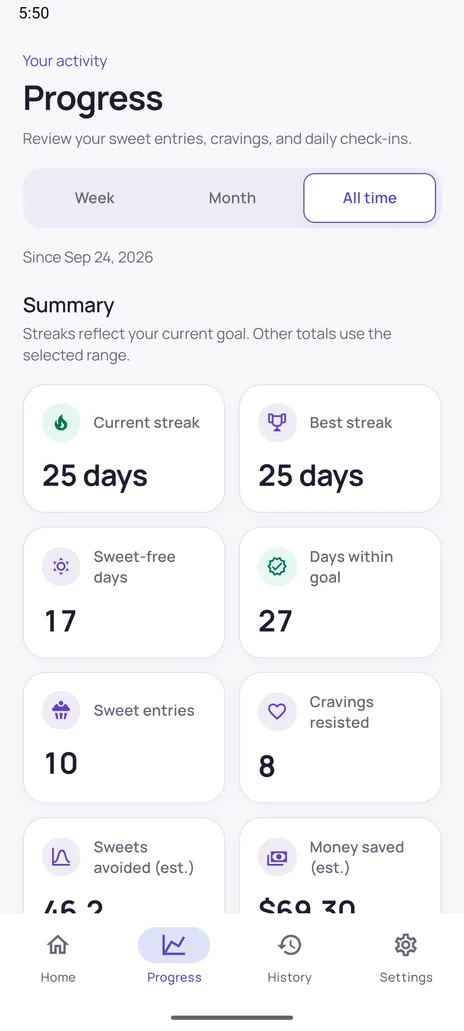
Quit Sweet keeps these numbers together on the Progress tab. The all-time view counts from your start date and shows your current and best streak beside sweet-free days, days within your goal, sweet entries and cravings resisted. Theprogress page explains how each figure is counted. If you record 30 days in a row within your goal, the app also unlocks its One Month achievement.
What to do after a 30-day no sugar challenge
Decide on purpose rather than letting day 31 decide for you. There are four sensible options, and none of them is a failure:
- Keep going. If the month felt manageable, carry on without an end date. Nothing needs to change except the calendar.
- Set a small daily limit. A daily allowance gives structure without a complete ban. The comparison ofquitting sugar cold turkey and cutting back gradually covers when a limit suits better than a full stop.
- Cut back gradually. A weekly target lets some sweets back in at a pace you choose, and makes it obvious if “a few” starts creeping up.
- Keep only the rules that worked. Perhaps no sugar in coffee and no sweets kept at home turned out to be easy. Those can stay even if the rest goes.
Whichever you choose, plan the first sweet after the challenge instead of treating day 31 as a free day. Choosing one thing you genuinely missed, and having it on purpose, is a very different evening from finishing everything in the cupboard.
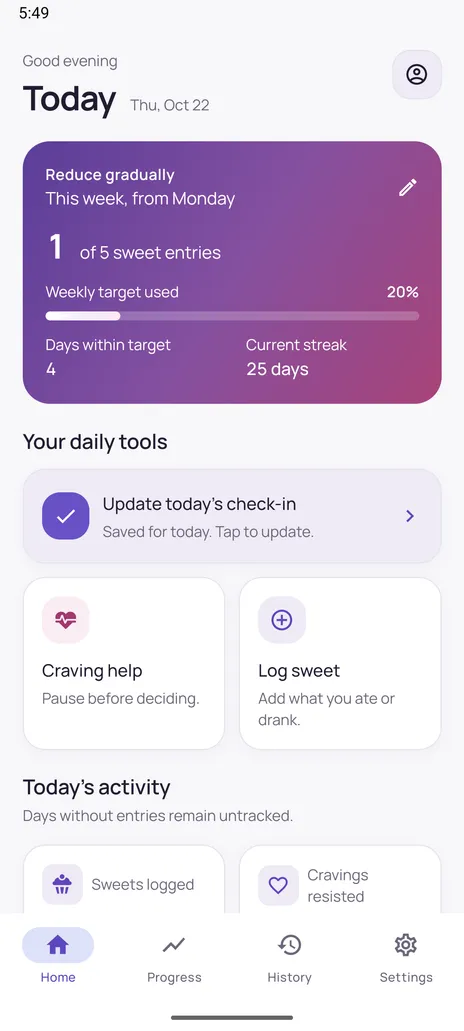
In Quit Sweet you can move from Quit sweets to Stay within a limit or Reduce gradually at any time. Changing the goal recalculates your statistics for the new mode, andyour earlier entries stay in your history.
Four mistakes that end a challenge early
Deciding the rules as you go
Every unclear food becomes a negotiation, and negotiations held halfway through a craving rarely go the way you planned. Five minutes with the list before day one saves dozens of those.
Swapping sweets for sweetened “healthy” snacks
Some cereal bars, flavoured yogurts and breakfast cereals list added sugars on the label. Under a no added sugar rule, check before you buy. Under the sweets-only version, decide whether they count, and write it down.
Counting blank days as wins
A run of unrecorded days looks like success and tells you nothing. Record the easy days too. They are the evidence that the challenge is working.
Treating the first slip as the end
One sweet on day 12 leaves 18 days of the challenge, and 11 sweet-free days already behind you. Log it, and carry on with the next meal.
Questions about the 30-day no sugar challenge
Can you eat fruit on a 30-day no sugar challenge?
Most versions of the challenge allow whole fruit. The World Health Organization’s definition of free sugars, the sugars public health advice asks people to cut down on, does not cover the sugars in fresh fruit. Fruit juice is different: its sugars do count as free sugars, so many challenges leave juice out.
Is honey allowed on a no sugar challenge?
Usually not. Honey and syrups count as free sugars under the WHO definition and as added sugars on US nutrition labels, so they are off the list in any version stricter than sweets only. If you decide to allow honey, write that into your rules before day one.
Do artificial sweeteners and diet drinks count?
They are not sugar, so it depends on the rules you set. Some people allow them. Others leave them out because the routine, such as a can of something sweet every afternoon, stays exactly the same. Either is reasonable if you decide before you start rather than in the moment.
What happens if I eat sugar during a 30-day challenge?
Record it and carry on from the next meal. Going back to day one is only necessary if that was the rule you chose at the start. Finishing all 30 calendar days and counting how many were sweet-free keeps a complete month of information, which is more useful than a count that keeps restarting.
Is 30 days long enough to break a sugar habit?
It is long enough to learn a lot about your habit, but it is not a guaranteed end point. Research on forming new daily habits found that the time it takes for a behaviour to feel automatic varies widely between people, from 18 days to an estimated 254 days. Treat day 30 as a review, then decide what to keep.
Should I do a no sugar challenge or cut back gradually?
A challenge suits people who find a clear line easier than a judgement call and can plan around the month ahead. If sweets are part of most days, or one slip tends to end a plan entirely, a weekly target or a small daily limit may be easier to keep going. Both can be tracked the same way.
Is there an app to track a 30-day no sugar challenge?
Quit Sweet is a free Android app that suits a challenge defined by sweets and sugary drinks. Its Quit sweets mode shows the time since your last sweet entry with your current and best streak, the Progress tab counts sweet-free days, and a 30-day goal calendar marks each day as within goal, above goal or not recorded. It counts sweet entries rather than grams of sugar, keeps data on your device and needs no account. It is not a medical service.
Start with the rules
A 30-day no sugar challenge is mostly decided before it begins. Write down what is off the list and what is allowed, choose what a slip means, and record every day, including the easy ones. On day 31, read the record and choose what comes next. The month is useful whether or not every day was perfect, as long as every day was written down.