
Quitting sugar cold turkey vs cutting back gradually
A total stop and a gradual cut fail in opposite ways. Here is how to tell which one fits the week you actually have.
Most people choose how to cut back on sweets in about ten seconds, usually on the evening of a day they would rather forget. The plan is either no sugar at all, starting tomorrow or I will just have less. Two weeks later it has quietly stopped, and the explanation people reach for is willpower.
Often it was the approach. Quitting sugar cold turkey and cutting back gradually fail in opposite ways: a total stop is brittle, so one ordinary birthday cake ends it, while "less" is vague enough to drift back to normal without anyone noticing. Which one suits you has surprisingly little to do with how much you like sweets. It has more to do with how predictable your week is, how you react to breaking your own rule, and how many decisions you are already making every day.
This guide compares the two properly, adds a third approach that most people skip, and shows how to tell from your own records — rather than from how you feel on a Tuesday — whether the one you chose is working.
What each approach actually means
The two phrases get used loosely, which is part of why the comparison is so muddled. Here is what each one commits you to.
Cold turkey: a complete stop
Cold turkey means no sweets at all, from a date you choose. There is one rule and no daily arithmetic — either you had something sweet or you did not. Progress is naturally measured as an unbroken run: the number of consecutive sweet-free days.
The strength is that it removes the decision. You are not weighing up whether this particular biscuit fits today's allowance while standing in front of it, which is a genuinely hard thing to do well. The weakness is the mirror image: because there is one rule, there is exactly one way to break it, and a single unplanned dessert ends a run you have been watching for three weeks.
Gradual reduction: fewer, against a target
Gradual reduction keeps sweets in your week but lowers how often you have them, measured against a target you set — say five a week instead of twelve. Progress is a count against that target rather than a run, so a sweet is data rather than a failure.
The strength is durability. Nothing is banned, so nothing triggers the all-or-nothing reaction, and a difficult week costs you a number rather than a streak. The weakness is drift: "less" is a comparison, and comparisons need a fixed starting point. Without an honest baseline written down somewhere, a gradual cut can return to your original habit over a couple of months while still feeling like progress.
A daily limit: the option most people skip
There is a third approach that rarely makes it into the cold-turkey-versus-gradual argument: a small fixed allowance every day. One sweet a day, every day, rather than none at all or a weekly budget to manage.
A daily limit borrows the useful half of each. Like cold turkey, it gives you one clear question with an obvious answer — has today's allowance gone or not? Like gradual reduction, it has no lapse condition, so nothing collapses when a week goes sideways. What it costs you is the days when one genuinely is not enough, and there is no borrowing from tomorrow.
The three approaches side by side
The differences that matter in practice are not about strictness. They are about how many decisions each approach asks of you, and what happens on the day it goes wrong.
| Cold turkey | Gradual reduction | Daily limit | |
|---|---|---|---|
| The rule | None at all, from a date you set | A weekly count you lower over time | A small allowance every day |
| How progress reads | Consecutive sweet-free days | Your count against your weekly target | Days you stayed inside the allowance |
| Decisions per day | One, and it is already made | Several — how much is "less" today? | One — has today’s allowance gone? |
| Easiest part | Nothing to negotiate in the moment | Nothing is forbidden, so nothing feels lost | Room for something planned |
| Hardest part | One lapse can feel like the whole thing failed | Noticing when "less" quietly became "the same" | Days when one is genuinely not enough |
| Choose it if | A clear line is easier than a judgement call | Sweets are threaded through your normal week | You want structure without a ban |
Five questions that decide it for you
Answer these honestly and the choice usually makes itself. None of them are about how much you like sweets.
1. What does one sweet usually lead to?
This is the question that decides it most often. If one biscuit reliably becomes six, then a daily limit is asking you to make a difficult decision at the exact worst moment — after the first one. Cold turkey deletes that moment. If one is genuinely one, a limit is far less effort to sustain and there is no reason to ban anything.
2. How predictable is your week?
Clean rules need stable conditions. If your weeks look broadly alike and you control most of your own meals, a total stop has a fair chance. If your week is full of other people's plans — shared meals, shift work, a rotating cast of birthdays — a rule with no give in it will meet something it cannot survive fairly quickly, and usually in week two.
3. How do you react to breaking your own rule?
Some people note the lapse and carry on unchanged. Others treat it as evidence the whole plan was naive, and stop. If you recognise yourself in the second description, that is a strong argument for an approach with no lapse condition at all. A weekly target or a daily limit cannot be "broken" in that way; it can only be exceeded, which is a number rather than a verdict.
4. How many decisions are you already making?
Gradual reduction quietly runs on arithmetic. How many have I had this week, how many does that leave, is today a day I can afford one. During a demanding period that arithmetic is the first thing to be dropped, and once it is dropped the target stops meaning anything. A single fixed rule — none at all, or one a day — needs no running total.
5. What are you actually trying to change?
Frequency and occasion are different problems. "I have something sweet six times a day, all over the place" is a frequency problem, and counting responds well to it. "I always have dessert after dinner, and only then" is a single occasion, and no counting approach touches it — what changes that is what happens at that specific moment, which is a job fora deliberate pause before decidingrather than for a target.
What each approach looks like day to day
Choosing on paper is easy. What you are actually signing up to is the screen — or the page in a notebook — that you will look at every morning for the next month. Quit Sweet is an Android habit tracker that supports all three approaches as goal modes, and its home screen changes shape depending on which one you chose, so putting the two extremes side by side makes the difference concrete.
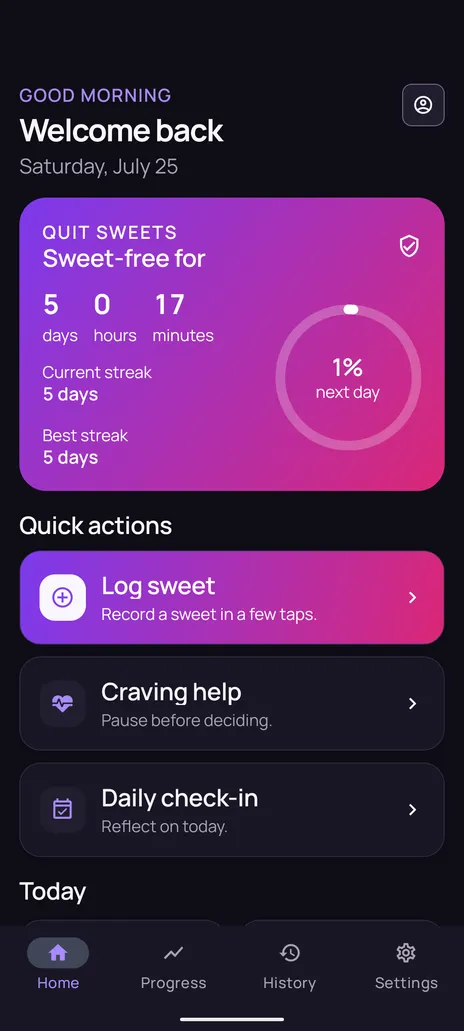
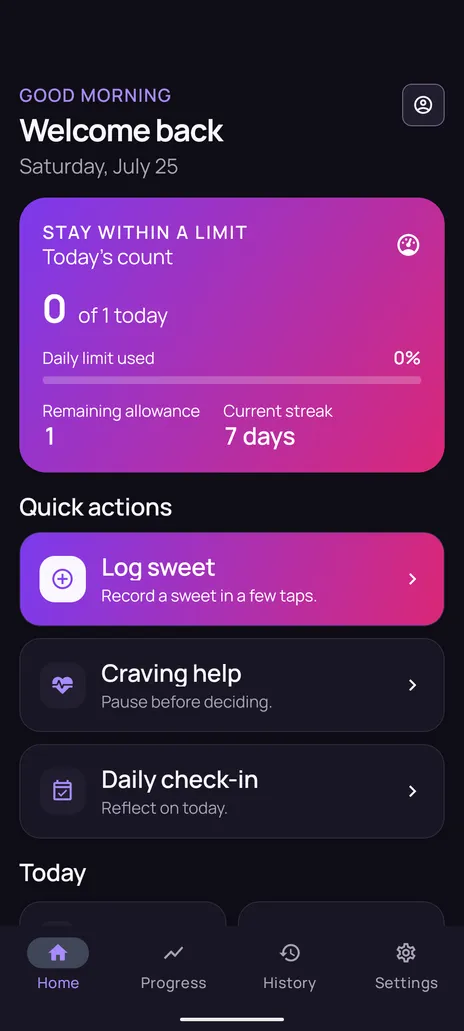
Notice what each screen asks of you. The first offers a number that only ever grows or resets to zero, which is highly motivating right up to the moment it resets. The second offers a number that refreshes every morning, which is less thrilling and much harder to lose. If you already know which of those you respond to, you have your answer — and if you are not sure, the app'sthree goal modes are all reachable from the same setup, so the choice is not permanent.
How long before you judge whether it is working?
Give it around 30 recorded days. Two weeks cannot tell the difference between a real change and an ordinarily quiet fortnight, and three months of an approach that is not working is time you did not need to spend. Thirty days you actually logged is enough to see a direction.
The word doing the work in that sentence is recorded. Judging an approach needs days you wrote down, and this is where most attempts quietly fall apart — not because the habit did not change, but because the record stopped after nine days and there is nothing left to read.
A month-long view makes that failure visible in a way a weekly count does not. This is the 30-day goal calendar from Quit Sweet'sprogress views, marking each day as within goal, above goal, or no data at all:
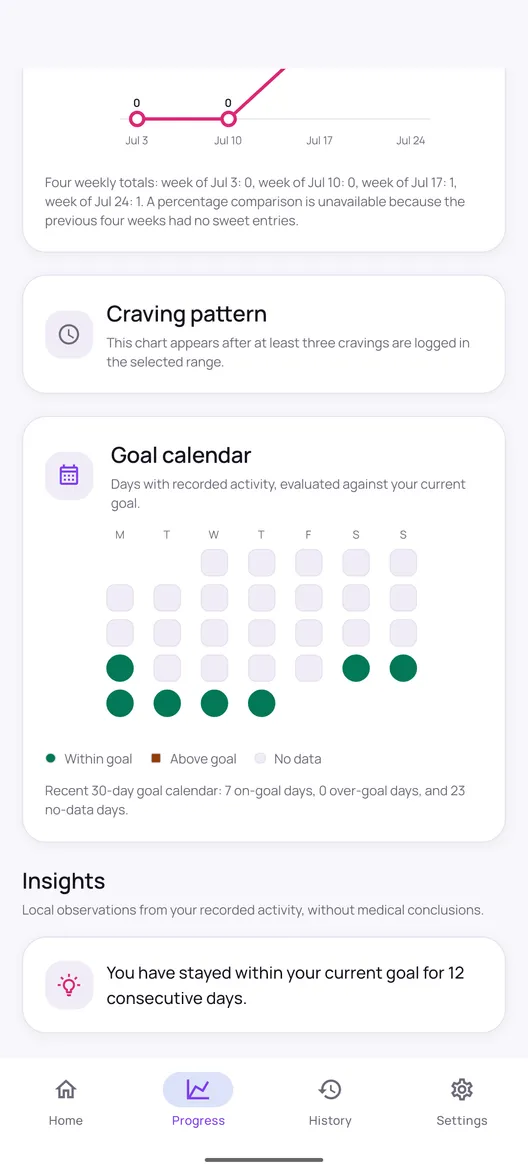
A month like that one is not evidence that the approach failed. It is evidence that the tracking did, which is a different problem with a different fix: make recording smaller, not the goal stricter. Any tracker worth using keeps "no data" and "stayed within goal" as separate states for exactly this reason — collapsing them turns every forgotten day into a fake success and makes the whole record useless.
When you do have a month of reasonably complete days, judge the trend rather than the best week in it. Four weekly totals moving from twelve to ten to nine to nine is an approach that is working. Twelve, four, eleven, three is a different pattern — that is alternating restriction and catch-up, and it usually means the target is set somewhere you cannot actually live.
What to do when you slip
Record it, keep the same approach for at least another week, and change nothing else that day. A single sweet tells you very little; what you do in the following three days tells you nearly everything.
It helps to separate two things that feel identical in the moment. A lapseis one occasion: a wedding, a bad afternoon, a box of chocolates in the office. Adrift is the pattern moving — three weeks where the count has crept back up and each individual instance had a reason. Only a drift is a reason to change approach. Reacting to every lapse as though it were a drift is how people end up having tried four approaches in six weeks and learned nothing from any of them.
The practical part is unglamorous: log the sweet the same way you would log any other, with the same detail and no extra ceremony. If a tracker makes recording a slip feel worse than not recording it, you will stop recording slips, and the record becomes a list of your good days only. Quit Sweet treats a logged sweet as ordinary data and keeps earned achievements earned, which is the behaviour to look for wherever you track.
Switching approach without starting over
Changing approach should cost you the plan, not the history. Keep every entry you have already made, recalculate against the new target, and carry on from where you are.
This matters more than it sounds. The most valuable thing you own after a month of tracking is a month of comparable entries, and it is exactly what a fresh start throws away. If switching approach means deleting six weeks of records, you will either stay on an approach that is not working or lose the only evidence you had.
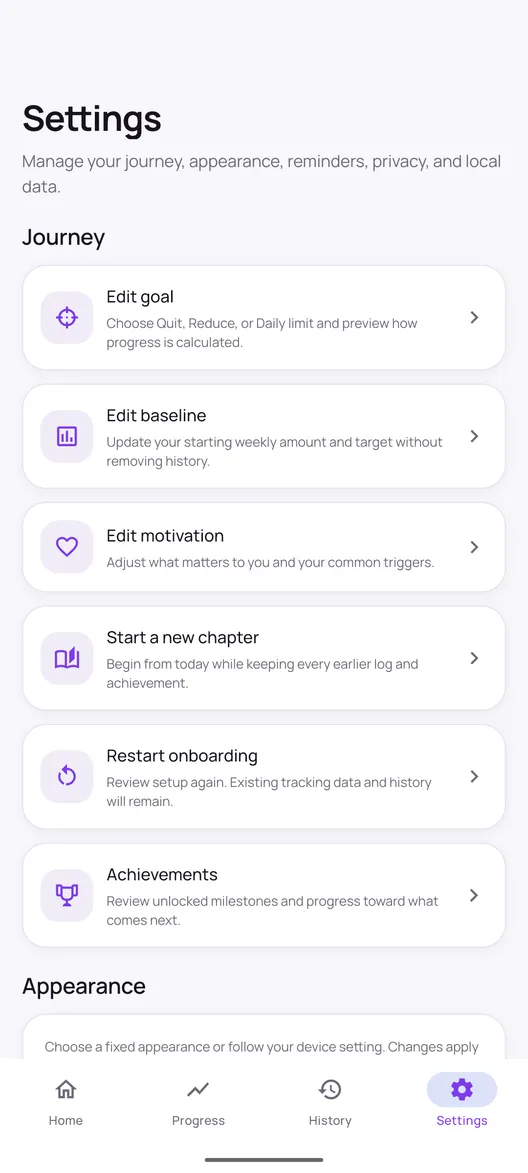
That gives you two distinct moves. Editing the goal changes the approach: your existing entries are simply re-read against the new target. Starting a new chapter draws a line under a period without erasing it — the honest option after a month you would rather not average into everything that follows. It is also worthrevising the baseline you set at the startonce you know your real starting number, because almost everyone guesses low.
Common mistakes with both approaches
These come up regardless of which approach you pick, and each one is avoidable in about a minute.
Picking the harder approach to prove something
Cold turkey is not the more serious choice, it is the more brittle one. If you are choosing it because gradual reduction feels like cheating, you are picking based on how the plan sounds rather than on whether you can run it.
Setting a baseline you wish were true
A gradual target is only meaningful next to an honest starting number. Estimate high rather than low: a baseline of six a week when the real figure is twelve produces a target you were already missing on day one, and a month of apparent failure that never happened.
Reading a missing day as a good day
A day you forgot to record is not a sweet-free day. Any tracking worth doing keeps those two apart, because a run of blanks means the tracking stopped, not that the habit did.
Changing approach every time a week goes badly
Switching resets the only thing that was accumulating: comparable data. Change approach when the pattern has clearly moved, not when a single week was hard.
Counting grams when frequency is the actual habit
If the problem is that you have something sweet six times a day, the number that needs to move is six. Looking up sugar content for each of those six is a second, harder task that usually ends the first one.
Starting in the worst possible week
A house move, a deadline or a week of other people’s celebrations is a bad first week for a rule with no give in it. Either start after it, or start with the approach that survives it.
If you would rather not keep the count in your head, Quit Sweet handles all three approaches, works offline, and keeps your records on your device.
Frequently asked questions
Is it better to quit sugar cold turkey or gradually?
Neither is better in general. Cold turkey suits people for whom one sweet reliably becomes several, and who find a single clear rule easier to hold than a judgement call. Gradual reduction suits people whose week already contains sweets in ways they cannot simply delete. The better approach is the one you can still follow on a bad day, not the one that sounds more disciplined.
How long should I stick with one approach before switching?
Give it about 30 recorded days. Two weeks cannot separate a real change from an ordinarily quiet fortnight, and three months of an approach that is not working is a waste. Thirty days of days you actually logged is enough to see a direction.
Does one sweet ruin a streak?
In a total-stop approach, yes by definition — a sweet-free run ends at the next sweet. That is arithmetic, not a verdict on you, and it is exactly why the streak is a poor scoreboard for some people. In a weekly-target or daily-limit approach one sweet is simply a count, and the run continues as long as you stay inside the target.
Do I need to count sugar grams to cut back on sweets?
No. Counting how often you eat something sweet is a complete method on its own, and it is far easier to sustain than looking up nutrition data for every item. Grams matter for nutritional questions; frequency is what you are changing when you are changing a habit.
What is the difference between a weekly target and a daily limit?
A weekly target lets you spend your allowance unevenly — four in one day and none for three days can still hit a weekly number. A daily limit spreads it flat, one small allowance each day, so there are no bank-it-up days and no catch-up days. Weekly targets suit uneven weeks; daily limits suit people who find an uneven week hard to steer.
Can I change my goal without losing my history?
In Quit Sweet, yes. Editing your goal recalculates the current statistics from entries you already saved and deletes nothing, and there is a separate option to begin a fresh run while keeping every earlier log and achievement. Whatever you use to track, look for that behaviour — a tracker that wipes your history when you adjust your plan is punishing the exact thing you should be doing.
Choosing, and then leaving it alone
Cold turkey and gradual reduction are not a strict option and a soft one. They are two different bets: one on the power of a rule with no exceptions, the other on the durability of something that bends. Read the five questions above, pick the bet that matches the week you actually have rather than the week you would like to have, and then leave the choice alone for thirty recorded days. Almost all of the value is in that last part.
This article is about method — how to structure and track a change — rather than about nutrition. If you have a health condition, take medication, or have questions about your own diet, those are questions for a qualified healthcare professional. Quit Sweet is a habit-tracking and motivational tool anddoes not provide medical advice, diagnosis or treatment.