
It is half past three in the afternoon, or nine at night, and the thought of something sweet will not go away. You have not decided to have anything yet. You just have a fair idea that you probably will.
Most advice on how to stop sugar cravings treats a craving as a single event to resist. In practice it has two parts: the few minutes when the urge is loudest, and the routine that brings it back at roughly the same time and place most days. Willpower gets spent on the first part. The second part is where most of the useful changes are.
This guide covers both. It explains how to tell a craving from ordinary hunger, gives a short routine for the moment one hits, matches responses to common triggers, and shows how a simple record helps you see the next craving coming. It is about habit rather than nutrition, and a notebook works as well as an app.
How do you stop a sugar craving?
First check whether you are actually hungry, and eat a proper meal or snack if you are. If it is a craving, pause, set a delay of a few minutes before deciding, and use that time to change your situation, for example by walking to another room. Afterwards, note the time and what set it off. A couple of weeks of notes can show when your cravings tend to arrive, so you can plan for that window instead of fighting each craving as it comes.
Is it a sugar craving or are you hungry?
A craving is an urge for a particular food, often one specific thing, that can arrive whenever you last ate. Hunger is a more general need to eat that most foods would satisfy. The difference matters because each one calls for a different response. Three quick questions usually settle it:
- Would a plain meal do? If a sandwich, a bowl of soup or a piece of fruit sounds fine, you are probably hungry. If only chocolate will do, it is a craving.
- When did you last eat? If it has been many hours, deal with that first. There is no virtue in out-waiting real hunger. Eat something ordinary, then see whether the urge for sweets is still there.
- Did something just happen? A stressful email, the end of dinner, walking past the biscuit tin. A craving that follows a clear prompt is often about the prompt rather than your appetite.
If the answer is hunger, eating is the solution, not a lapse. The rest of this guide is about the other case.
What to do when a sugar craving hits
The aim in the moment is not to win a contest of willpower. It is to turn an automatic reach into a decision you make a few minutes later, with a little more information. The routine below has five parts, takes only a few minutes, and works anywhere. It follows the same order as Quit Sweet’sfive-step craving pause, but you do not need the app to use it.
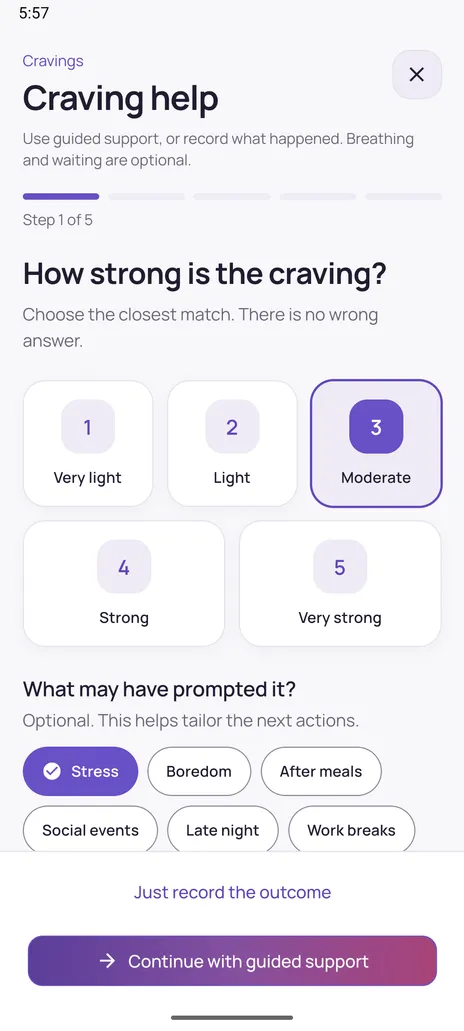
1. Name the craving and rate how strong it is
Tell yourself, or write down, that this is a craving and how strong it feels on a scale of one to five. That sounds trivial, but it moves you from reacting to observing, and it produces a number you can compare later. A moderate craving at your desk and a very strong one at 10pm are different problems with different fixes.
If you also note what may have prompted it, such as stress or the end of a meal, you are already collecting the detail that makes patterns visible.
2. Take a short breathing pause
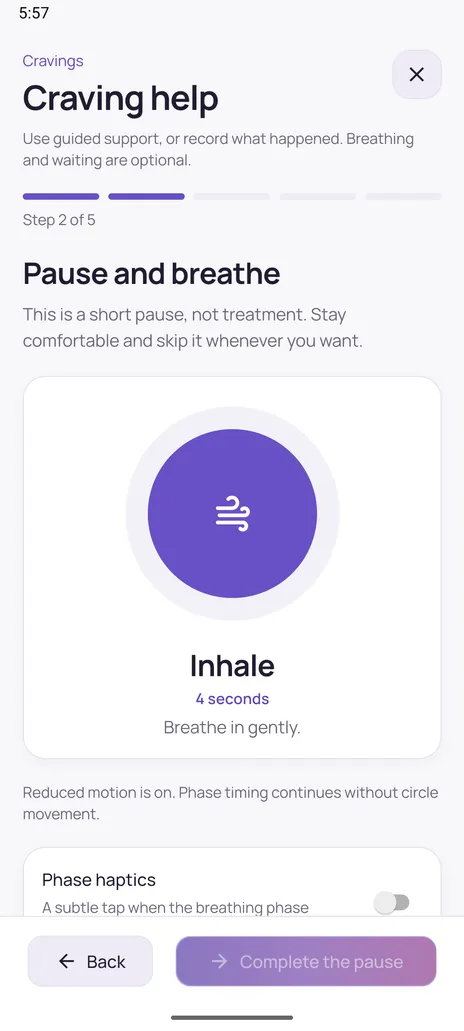
A few slow breaths will not make a craving disappear, and nobody should promise that they will. What a breathing pause does is put a small, deliberate gap between the urge and the action, which is the gap the next step needs. A handful of slow, even breaths is enough. There is no technique to get right.
3. Delay the decision with a set time
Instead of telling yourself “no”, tell yourself “not for five minutes”. A delay is easier to agree to than a ban, and it moves the decision to a moment when the urge may have changed. It may also be just as strong when the time is up. That is fine: the point is that you decide on purpose rather than on autopilot.
Use a timer rather than guessing. Three, five or ten minutes are practical lengths, and they are the options Quit Sweet offers at this step. Its timer keeps counting if you switch to another app, and you can finish early at any time.
4. Do one thing that changes the situation
Spend the delay on something that changes where you are or what your hands are doing. The best choice depends on the trigger, but a few work almost anywhere:
- Drink a glass of water or make a hot drink.
- Walk to a different room, or outside for a few minutes.
- Message or call someone.
- Move away from wherever the sweets are kept.
None of these is a cure. They are simply easier to start than pure resistance, and they take you out of the spot where the habit usually happens.
5. Decide, then write down what happened
When the timer ends, make the decision. If the craving has passed, note that. If you still want the sweet and choose to have it, have it deliberately and note that too. Either way, record the time, the trigger and the outcome. Those three details are what the rest of this guide relies on.
An honest record includes the times you ate something. If you only log the cravings you resisted, you end up with notes that describe your good days and none of the moments you most need to understand.
Match the response to the trigger
The same response does not suit every craving. A craving that comes from stress needs something that deals with the stress. A craving that comes from seeing a box of biscuits needs the biscuits out of sight. Naming the trigger is what lets you choose the right response, rather than reaching for the same tip every time.
| Trigger | What it often looks like | Something to try |
|---|---|---|
| Stress | Reaching for something sweet during a hard task or straight after a difficult conversation. | Step away from the task for a few minutes first. Deal with the stress, then decide about the sweet. |
| Boredom | Wanting something sweet when there is nothing in particular to do, often at home. | Start a small task that uses your hands, such as tidying a shelf or making a call. |
| After meals | Dessert has become the way every meal ends. | Give the meal a different ending: a hot drink, a short walk, or clearing the table straight away. |
| Social events | Cake at work, birthdays, shared plates, being offered seconds. | Decide before you arrive whether you will have some and how much. A plan made earlier is easier to keep than one made at the table. |
| Late night | A craving after dinner while relaxing, scrolling or watching TV. | Use a clear “kitchen is closed” cue, such as brushing your teeth, and keep sweets out of the room you relax in. |
| Work breaks | The vending machine or café run has become the break itself. | Decide what the break will be instead, and bring a drink or snack you actually like from home. |
| Seeing sweets | A bowl on a colleague’s desk, a checkout display, a tin on the kitchen counter. | Change the route or the storage: out of sight, in an opaque tin, or not bought in the first place. |
These seven are also the trigger tags in Quit Sweet’s craving log, alongside the option to add your own. If one trigger dominates your notes, start there. Fixing your response to one recurring trigger is a smaller and more achievable change than trying to be ready for all of them at once.
If the craving is usually for a sweet drink rather than food, the guide tocutting down on sugary drinks covers swaps for specific drink occasions.
Why do sugar cravings come at the same time every day?
Cravings often repeat at the same time because they are attached to a routine rather than to the food itself: the mid-afternoon dip at work, the end of dinner, the hour on the sofa once the house is quiet. The time, the place and the activity act as the cue. That is why a craving that feels random can turn out to be quite predictable once it is written down.
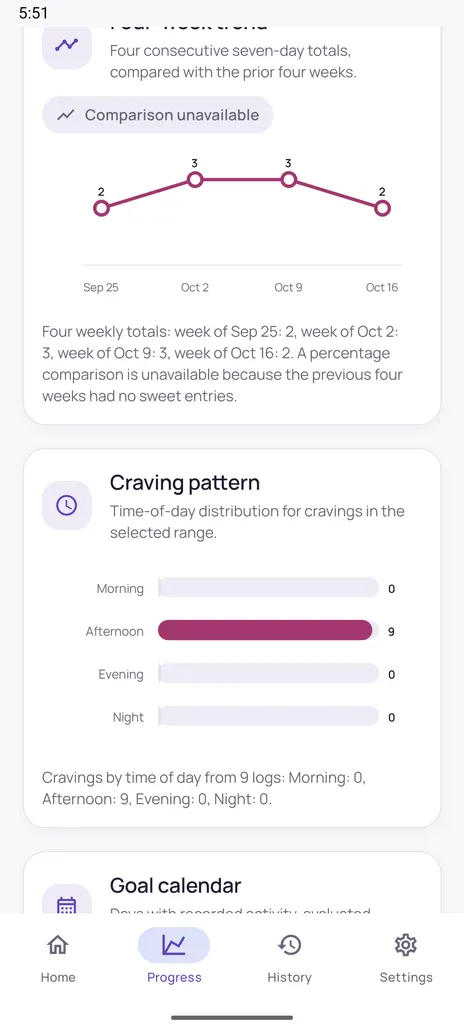
To find your window, record every craving for two weeks with the time it happened, including the mild ones. Then group them roughly into morning, afternoon, evening and night. If one or two windows hold most of the entries, you have found where to focus your effort.
Quit Sweet does this grouping for you. The Progress tab sorts craving logs by time of day using the time saved with each one; theprogress page explains what else is counted there.
Sugar cravings at night
Evening and night cravings can be harder to handle because several triggers stack up at once: tiredness at the end of the day, unstructured time, the end of dinner, and sweets kept at home. A few changes target that combination directly:
- Check what you ate earlier. If lunch was skipped or small, part of the evening craving may be hunger, and a proper dinner is the fix.
- Give the evening a closing routine. A hot drink, brushing your teeth, or switching off the kitchen light once it is tidy all mark the end of eating for the day.
- Move the supply. Keep sweets out of the room where you relax, or stop keeping a supply at home for a while.
- Test the tiredness question. Adaily check-in that records energy and craving level lets you compare low-energy days with high-craving evenings. Whether tiredness plays a part for you is something your own records can answer.
Sugar cravings in the afternoon
Afternoon cravings often attach to the working day: a dip in focus, a break with nothing planned, a shared snack drawer. Plan the break itself, with a walk, a drink you like or a snack you chose that morning, so the craving is not simply filling a gap.
Plan for your craving window before it arrives
Once you know when cravings usually arrive, decide your response before that time comes. A plan made in the morning means the 3pm decision has already been made, and you only have to follow it. Useful preparation is concrete:
- Put the replacement where the decision happens: water on the desk, a chosen snack in your bag, a hot drink ready for after dinner.
- Change the route past the trigger: a different way back from the meeting room, or a shop without the checkout display.
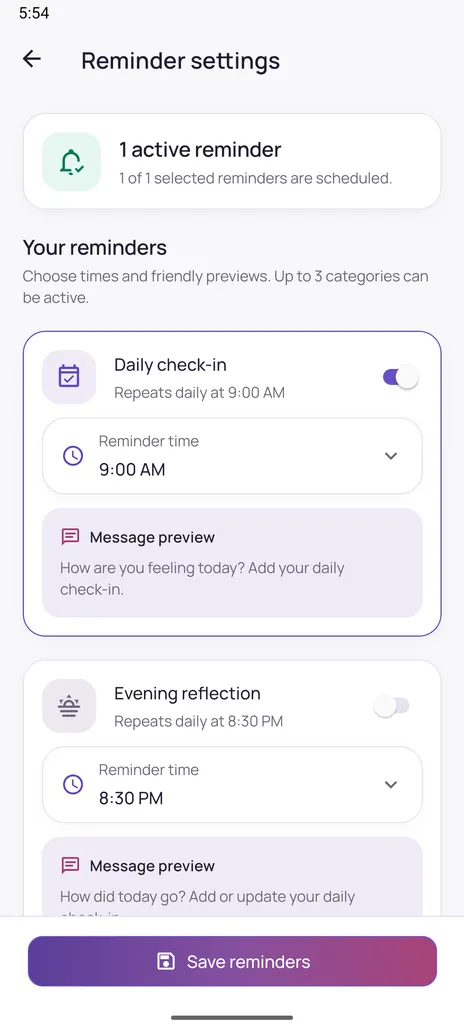
- Set a reminder shortly before the window, so the plan reaches you before the craving does.
Quit Sweet’s local reminders can handle the last part. Up to three reminder categories can be active, including one for a high-risk time you choose, and you can set each time yourself and preview the message before turning it on.
What if you eat the sweet anyway?
Then you had a sweet. Record it with the real time and trigger, and carry on with the rest of the day as planned. One sweet after a craving is not evidence that the method failed; it is another data point about when and why the habit shows up.
What matters more is the next few hours. Treating one sweet as a reason to write off the whole evening is how a single craving turns into a long one. If that pattern sounds familiar, the guide torestarting after a broken streakcovers it in detail.
Do sugar cravings go away?
There is no reliable timeline, and anyone who promises one is guessing. Cravings vary between people and situations. What you can do is measure your own: if your notes show fewer cravings, or lower intensity ratings, across several weeks, they are changing for you.
Compare like with like. Count cravings per week and look at the intensity ratings, rather than judging from how today felt. One bad day says little; four weeks of entries say a great deal more. In Quit Sweet, every craving keeps its intensity, trigger and outcome in the Cravings tab of History, so that comparison uses what you recorded rather than what you remember.
Whether to keep sweets in your week at all while you do this is a separate decision. The comparison ofquitting sugar cold turkey and cutting back gradually walks through how to choose.
Four common mistakes with sugar cravings
Planning only for the moment
If every decision is made mid-craving, it is made at the worst possible time. A plan for your usual window does more work than any in-the-moment trick.
Keeping the trigger within reach
Banning sweets while keeping a full tin in the cupboard asks for a fresh decision every time the cupboard opens. Changing what is around you is usually easier than resisting it.
Mistaking hunger for a craving
Going for hours without eating and then fighting an evening craving is often a fight with hunger. Eat something ordinary, then see what is left.
Recording only the cravings you resisted
A record of wins alone cannot show when you are most likely to eat something sweet, which is the thing you most need to know.
Questions about sugar cravings
What is the fastest way to stop a sugar craving?
There is no instant switch. The quickest practical approach is to check that you are not simply hungry, then delay the decision by three to ten minutes and change your situation while you wait, for example by walking to another room or making a drink. That turns an automatic reach into a deliberate choice.
Why do I crave sugar after every meal?
Often because dessert has become the way a meal ends. Finishing the meal is the cue, and the sweet is the routine that follows it. Giving the meal a different ending, such as a hot drink, a short walk or clearing the table, replaces the routine instead of relying on resisting it every time.
Why do I crave sugar at night?
Evenings can combine several triggers at once: tiredness, unstructured time, the end of dinner and sweets kept at home. Check whether you ate enough earlier in the day, give the evening a closing routine, and keep sweets out of the room where you relax. Two weeks of notes will show whether night really is your main window.
How long does a sugar craving last?
There is no dependable figure that applies to everyone, and it varies with the situation. Rather than relying on a number, time your own: set a three, five or ten minute delay and note whether the craving had eased when it ended. After a couple of weeks, your records give you an answer that fits you.
Does drinking water help with sugar cravings?
Water is not a proven cure for cravings, but it is a useful replacement action. It is available almost anywhere, it gives you something to do during a delay, and it replaces a sweet drink if that is what you usually reach for. Whether it helps you specifically is something your own notes can show.
Should I cut out sugar completely to stop cravings?
Some people find a complete stop easier because there is no decision left to make. Others find a total ban harder to keep and fall back into all-or-nothing thinking after one sweet. Neither approach is guaranteed to end cravings, so choose the one you can still follow on a difficult day.
Can an app help with sugar cravings?
An app cannot remove a craving, but it can make a routine easier to follow and a pattern easier to see. Quit Sweet, a free Android app, offers a five-step craving pause with breathing, a 3, 5 or 10 minute delay and alternative actions, records each craving’s intensity, trigger and outcome, and groups cravings by time of day. Data stays on your device and no account is needed. It is not a medical service.
Next time a craving hits
Check for hunger, rate the craving, give it a few minutes, and change your situation while you wait. Then write down when it happened and what set it off. The moment gets most of the attention, but the notes are what make next week easier: once you can see your window, you can plan to be somewhere else, doing something else, when it arrives.