
Broke your sugar-free streak? How to start again without starting over
A streak resetting to zero and your progress resetting to zero are two different events. This is about telling them apart, and about what to do with the day that follows.
The counter said eighteen days. Then there was a slice of birthday cake, and the next time you opened the app it said zero.
What happens in the hours after that number resets tends to matter far more than the cake did. One dessert is one dessert. The expensive part is the reasoning that follows it — the run is ruined, the week is a write-off, there is no point logging anything until Monday. People who have tracked carefully for a month stop tracking entirely, and the gap they leave in their own records costs them more than the slip.
This guide covers what actually changes when a streak resets, the handful of things worth doing in the first day afterwards, how to tell a one-off from a pattern, and how to restart without throwing away what you already know about your own habit.
Short answer
A broken streak resets one counter. It does not delete your logs, your craving patterns, or anything you have learned about when the habit shows up. Record the sweet accurately, note what the day was like, and keep tracking through the rest of the week. Change your goal only if the same slip keeps repeating — not on the day it happens.
Why one sweet turns into a week off
Because a streak is binary and a week is not. Every day is either on the run or off it, with nothing in between — which is exactly what makes a streak motivating while it is alive, and exactly what makes it an argument for giving up the moment it ends. Once today is already lost, the streak has nothing left to protect, so the rest of the day gets rounded down. Then the rest of the week does.
The count of sweets you eat does not work that way. Three in a week where you used to have twelve is a real change, and no streak counter can express it. A day that went badly at 4pm can still finish better than the day before it. Those distinctions only exist if you are still counting, which is why the habit worth protecting after a slip is the tracking, not the number.
This is also why the day of a slip is the worst possible day to make a decision about your plan. You are judging a whole approach from its single worst data point, at the moment you are least inclined to be fair about it.
What a streak actually measures
A streak measures consecutive days that met the goal you chose — and "met the goal" means something different in each goal style. It is worth knowing which rule is actually yours before deciding you broke it.
- Quit sweets. Consecutive sweet-free days, counted from your most recent sweet entry or your journey start date. One logged sweet ends the run.
- Reduce gradually. A day counts when its rolling seven-day total sits at or below your weekly target. A single sweet may leave the streak intact, depending on the six days around it.
- Stay within a limit. A day counts when it stays inside your daily allowance. A sweet that fits inside the allowance breaks nothing.
People in the second and third modes sometimes react to a sweet as though they were in the first, and grieve a streak that has not actually ended. Thethree goal styles are described in full on the How It Works page, and the exact counting rules are set out inhow streaks work.
Worth being equally clear about what a streak does not measure: how strong the craving was, whether you paused before deciding, whether this month is better than last month, or how much you now know about your own triggers. None of that survives in a single number, and all of it survives in your records.
The first day after: five things worth doing
None of these take more than a minute, and the order matters more than the effort.
1. Log it, with the real time
Recording the sweet is the one step that genuinely changes what you can do later. The category and timestamp are what turn a bad evening into a data point, and a data point into a pattern you can act on. Backdating it to look tidier, or leaving it out entirely, buys nothing and costs you the entry.
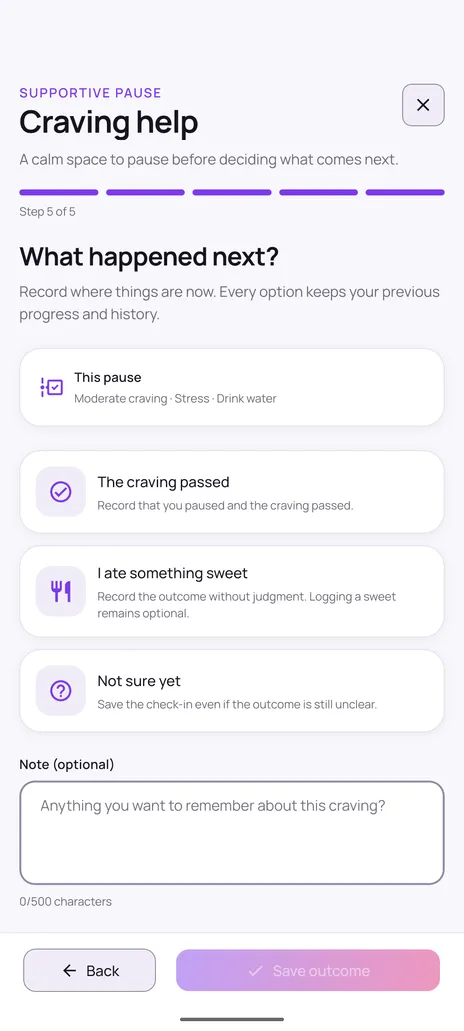
In Quit Sweet this holds even inside the craving flow. If you opencraving help and then eat something anyway, "Ate something sweet" is one of the three ordinary outcomes on the final screen — not an error state, and not something the app comments on.
2. Write down what the day was actually like
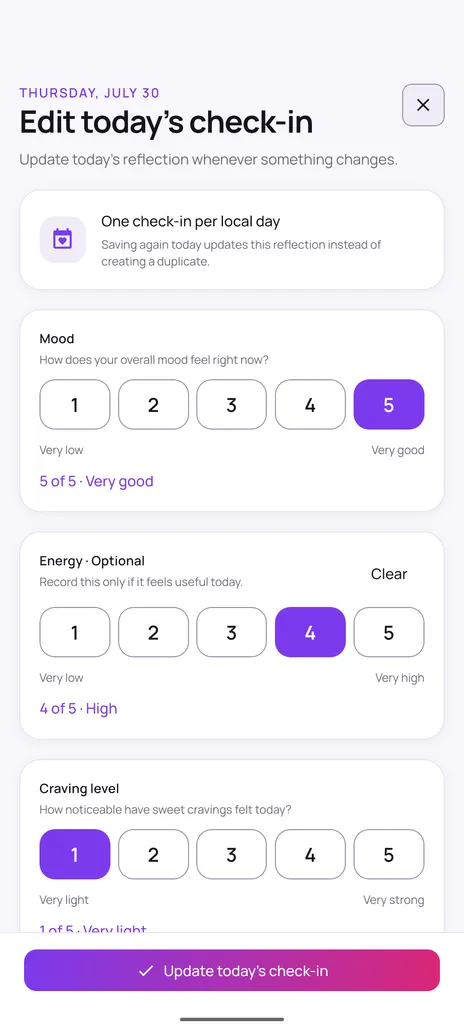
A slip on a day you would already have rated a two out of five reads very differently from a slip on an unremarkable Tuesday. The daily check-in takes three taps — mood, optional energy, and how noticeable cravings felt, each on a one-to-five scale — and it is the only part of the record that captures the conditions rather than the event.
3. Leave your goal alone for now
Changing your target on the day you missed it is a decision made with the least useful information you will ever have about it. Give it a week. The section on telling a wrong goal from an unusual week below covers what to look for once you do have the data.
4. Aim at tomorrow, not at the streak
Rebuilding eighteen days is not a plan; it is the same eighteen days you already did, restated as a debt. One on-goal day is a target you can actually hit within twenty-four hours, and streak length takes care of itself after that.
5. Treat the next craving as its own event
A second craving the same evening is a separate decision, not a continuation of the first. The five-step pause — rate it, breathe, delay by three to ten minutes, pick one small alternative, record what happened — is designed to be used repeatedly in a day, and each run is logged on its own.
Read the week around the slip, not the slip itself
The useful information is almost never in the entry you just made. It is in the three or four days around it, which is where the conditions were building while nothing appeared to be wrong.
The weekly chart is the fastest way to see that. It plots the last seven days against your goal line, with four consecutive weekly totals underneath for a longer view.
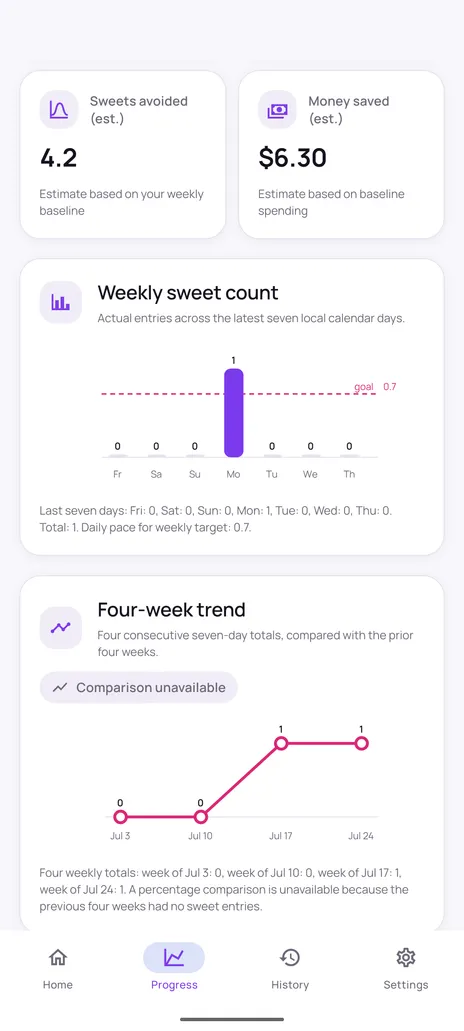
Three questions the charts answer that a streak counter cannot:
- Was it one day, or the week? A single bar above the goal line in an otherwise flat week is a Tuesday, not a trend. A week where every bar sits slightly high is a different problem with a different fix.
- Is this week actually worse than the last three? Four consecutive weekly totals is about the shortest span where a direction becomes visible. A single week read in isolation almost always looks worse than it is.
- Are there days with nothing recorded at all? This is the signal most people miss. Tracking tends to stop slightly before a habit does, so a run of empty days leading into a slip is often the earliest warning available. The thirty-daygoal calendar marks no-data days as clearly as over-goal days, which is what makes that gap findable at all.
Timing deserves its own look. Craving logs are grouped into morning, afternoon, evening and night on thecraving pattern view. If most of yours land in one window, that window is worth preparing for specifically, rather than trying to stay vigilant all day.
Everything on those screens is calculated on your device from entries you made. Two of the figures shown alongside them, sweets avoided and money saved, are explicitly estimates derived from the baseline you typed in during setup, and are worth reading as direction rather than measurement.
Was the goal wrong, or was the week?
The goal is the problem when the same result keeps repeating under ordinary conditions. The week is the problem when the conditions were not ordinary. The distinguishing feature is repetition, and repetition takes a few weeks to establish — which is the entire reason not to decide on day one.
Signs the week was the problem
- This is the first slip in several weeks.
- Something specific made the week atypical: travel, illness, a hard stretch at work, a holiday, a house full of leftover cake.
- Most days in the last month were still within goal.
Signs the goal was the problem
- The same slip has happened in the same situation three or four weeks running.
- You have more no-data days than logged days, which usually means the plan is asking for more attention than you can currently give it.
- You chose quit sweets and have never held it longer than a couple of days. A target you have not met once is not yet a target.
If it is the goal, the follow-up question is which of the threegoal modes to move to, which is a longer decision than this article covers — the comparison ofquitting sweets outright against cutting back gradually walks through it properly. The mechanical part is reassuringly small either way:changing your goal recalculates your statistics from entries you have already saved rather than clearing them.
What carries over when you restart
Restarting is a decision about the counter, not about the record. In Quit Sweet, four things survive a broken streak intact:
- Every sweet, craving and check-in you logged stays in your history.
- Your best streak stays on record, even though the current one is back at zero.
- Achievements you have already unlocked stay unlocked. They are not taken back for a bad day.
- Switching goal mode recalculates your current statistics from saved entries. No history is deleted in the process.
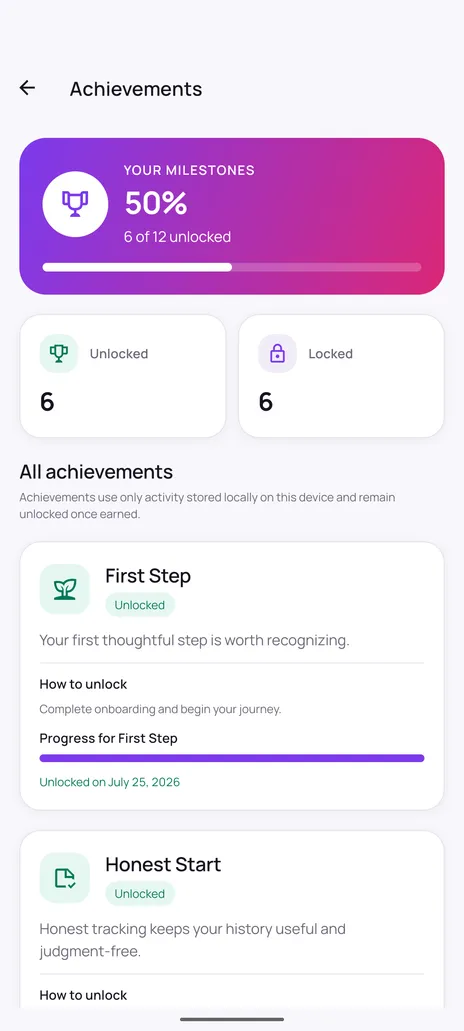
If the restart feels like it needs a line drawn under it, Settings has a "Start a new chapter" option that begins a fresh run from today while keeping every earlier log and achievement. It is the difference between turning a page and burning the notebook.
The FAQ covers the same ground from the other direction:what happens if you log a sweet after a long streak.
Four mistakes that turn one day into a month
Deleting the entry
A tidy history is worth nothing. The entries you would rather not look at are the ones carrying the trigger, the time and the context, and removing them leaves you with a record that only describes your good weeks.
Restarting on a harder setting
Missing a target and responding by tightening it is a common reflex and a reliable way to miss it again. If anything needs to move on the day after a slip, it is usually the difficulty going down, not up.
Waiting for Monday
Waiting for a clean starting line converts one slip into five or six unlogged days. There is no accounting benefit to it — the calendar counts each day on its own, so Thursday afternoon is as good a restart as any Monday morning.
Only tracking the good days
Selective logging produces charts that look better and help less. It also quietly inflates every figure derived from your entries, so the streaks and counts stop describing anything real.
Questions people ask after a streak resets
Why do I give up completely after one slip?
Because a streak counter is binary and the rest of your week is not. Once the run has ended there is nothing left for that day to protect, so the day gets written off, and then the week does. Switching your attention to a count you can still improve — sweets this week against sweets last week — gives the remaining days something to be measured against again.
What should I do the day after breaking a streak?
Three things, none of which take a minute. Record the sweet with its real time, add a daily check-in so the conditions are on record alongside the event, and set a target for tomorrow only. Leave the goal itself untouched until you have another week of entries to judge it by.
Should I start over completely after breaking a streak?
Only the counter needs to start over. Your logged sweets, cravings and check-ins stay where they are, and so does anything you learned from them. Deleting your history to get a clean slate removes the one thing that makes the next attempt better informed than the last one.
How long does it take to rebuild a streak?
Exactly as long as it took the first time, which is why rebuilding it is a poor target on day one. A single on-goal day is something you can reach within twenty-four hours. Streak length is a by-product of repeated on-goal days rather than something you can aim at directly.
Is it worth logging a sweet once the streak has already gone?
Yes, and it is the entry most worth making. A recorded slip keeps its time, category and any trigger you noted, so it can join a pattern later. A skipped one leaves a blank day that looks identical to a day you simply forgot to open the app, which is the version that teaches you nothing.
Does a broken streak delete anything in Quit Sweet?
No. A streak ending changes the current count and nothing else. Earlier entries stay in your history, your best streak stays on record, and achievements you have already unlocked stay unlocked.
Starting again
A streak is a useful piece of encouragement and a poor summary of a month. The version of progress worth defending is the one made of logged days, honest entries and patterns you can point at — and none of that resets when the counter does. Log the slip, keep the week going, and give any decision about the goal itself a few weeks of evidence first.
Track the whole week, not just the good days
Quit Sweet keeps sweets, cravings and check-ins on your device, so the record you build after a difficult week is yours to read and nobody else's.